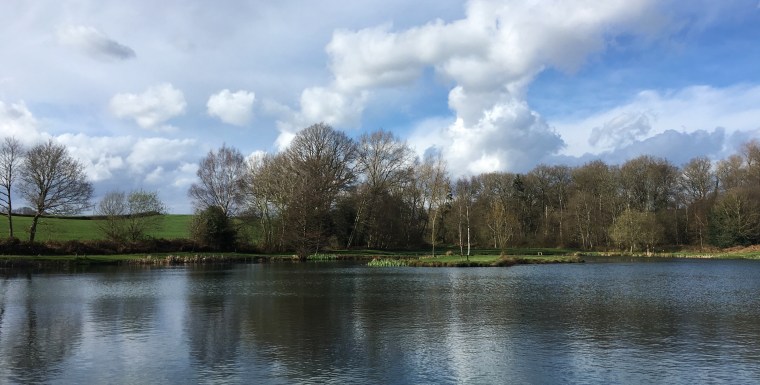
Water Meadows

I was curious about the effect of recent heavy rain on the river. I decided to go and have a look. The North River at Billingshurst was very high,  it was over the banks and into the surrounding fields. The fields on both sides of the bridge looked like fifty acre lakes. The water was coloured by the mixture of clay and greensand it flows through. A milky-caramel colour,  not very attractive. As I drove towards Petworth the heavy rain turned to sleet.

I stopped at Rotherbridge where the river had remained within it’s banks. Between 1791 and 1794 eleven miles of the river between Midhurst and Stopham were made navigable. Barges brought coal for the iron works and took local stone away. Consequently, the river there is deeper and straighter than nature intended.

The Rother is an old, lowland river with a wide floodplain and extensive water meadows. The entire river valley has been designated as a Site of Nature Conservation Importance (SNCI). The winter floods warm the soil and deposit silt which enriches the pastures. That improves the summer grazing and the biodiversity of the fields. However, the floods also wash ammonium nitrate fertilizer and silt into the river.

I stood on the bridge wondering how the trout had faired during the mild and dry winter. There should be a few sheltering in the roots of the Willow and Alder trees beside the bridge.  I made a mental note to start my season on the river at Rotherbridge.

img_2467

I went downstream beyond Kilsham Farm and looked across the fields towards The Badgers. The water meadows were flooded but I could clearly see the course of the river. There was no danger of the pub flooding,  unlike December 2013 when the top of the bar was underwater.

Unfortunately, I had to attend a meeting in Petworth and a visit to The Badgers was out of the question. I consoled myself with a nice bottle of Fleurie from the wine merchants in the town.

trout

Leaders

It’s snowing and I’m looking out into the garden, wishing the time away. The start of the trout season, in early March, doesn’t seem to be getting any closer. I’ve cleaned my reel several times and tied a few flies to replace those mangled by trout and lost in the trees. One essential task is to renew the leader on my fly line. I use a nine foot tapered leader that is 6lb breaking strain at the business end.

There is a lot of rubbish talked about leaders. Forty years ago a length of heavy nylon was nail knotted to the end of a fly line and terminated in a suitably fine tippet. It was simple and it worked well. Not today. It has to be French, Czec, Euro, braided, sinking, floating, loop-to-loop, with a micro ring etc. I don’t relate to any of that tackle-trade techno jargon. Simple is best. I glue the end of my leader into the fly line and attach a 4lb breaking strain tippet with a four turn overhand knot. I use Leeda tapered leaders and Stroft GTM for tippets. That combination works well for both nymph and dry fly.

img_0662

I dip the end of my Cortland 444 peach classic into nail varnish remover for about a minute. That softens the plastic coating which can be stripped off with a thumb nail to reveal the braided core of the fly line. I dry the braided core with a tissue to remove the excess solvent. I remove the enormous, badly tied knot from the thick end of the leader. Why Leeda bother with this knot is a mystery. Either the knot or the loop are guaranteed to jam in the rod rings.

img_0664

I twiddle the butt of the leader inside the braid until the end of the leader is next to the plastic coating of the fly line. A small drop of superglue is drawn up the braid by capillary action, inside the plastic coating. After the glue has dried I paint the joint with a permanent flourescent yellow marker pen. Another coating of superglue finishes the joint.

img_0677

It takes about ten minutes, mostly waiting for the superglue to set. It’s simple, waterproof and tough. The joint runs through the rod rings and has never let me down. The yellow marker pen highlights the tip of the fly line when I’m fishing deep with a nymph or buzzer. I put Gink on the leader if I want it to float and run it through a lump of mud if I want it to sink.

No clunky braided loops to get caught in the rod eyes or drag the tip of the fly line under water. No leader knots or micro-rings. Simple.

trout


Leconfield Fly Fishing Club

Except for an invitation to fish the River Wey, my trout fishing in 2016 was solely on club waters. I had nine lakes and over three miles of river to choose from. I didn’t want to fish anywhere else. The club only has about a hundred members,  it’s small and friendly.

Leconfield Estates own much of Petworth and the surrounding area. In fact, 14,000 acres of the surrounding area. Part of Petworth House and deer park are owned by the National Trust. The NT don’t approve of fishing or hunting or shooting. Thankfully, the Manor of Petworth and the Leconfield Estates have been held by Lord Egremont and his ancestors since 1150.

2749

The lakes and river are lightly fished and it’s rare for me to meet another member,  particularly during mid-week.  The river runs through traditional farmland and is sensitively maintained. It rises on a mixture of greensand and chalk, then flows through the South Downs National Park. The river is a designated Site of Nature Conservation Importance because of its value to wildlife. I feel privileged to be able to explore the river and visit the lakes which are in parts of the estate to which the public have no access.

The lakes open in March, it’s a long time to wait. While waiting, I designed and built a new website for the club. Everyone is happy with the design.

This link is the club’s home page https://leconfieldflyfishingclub.com/

trout

9 January – Tying Flies

It’s cold, grey and windy. Time to tie some flies for the new season. The lakes open in March. The Gold Ribbed Hare’s Ear (GRHE) nymph and Black Spider are my favourite flies. I use them a lot and they therefore catch the majority of my trout.

Gold Ribbed Hare’s Ear

This fly has a long history. In 1886 Frederic M. Halford published Floating Flies and How to Dress Them. He included the Gold Ribbed Hare’s Ear. In 1910 G. E. M. Skues listed the Hare’s Ear pattern as a wet fly in his classic Minor Tactics of the Chalk Stream. The history of this pattern therefore neatly tracks the Skues – Halford debate.

The modern pattern featuring a gold bead and wide gold ribbing is, in my opinion, a lure not a nymph. I don’t use beads. I use rabbit fur and various wire ribbings for this pattern.  Rabbit fur is plentiful. Lead copper and gold coloured wire are cheap and more durable than tinsel or Lurex. The tail of the fly is made from the coarse guard hair which is pale brown with dark tips. The body is dubbed with a mixture of guard hair and the soft blue under fur. The ribbing sinks into the body which secures it and gives a segmented effect. Lead wire ribbing makes the fly sink and I sometimes add lead wire under the thorax for very deep pools. The thorax is mainly guard hair, loosely dubbed and picked out with a needle. I don’t bother with wing cases. This pattern should look scruffy and is more successful in sizes 12 and 14. I find trout take this fly confidently throughout the season.

Black Spider

blackspider

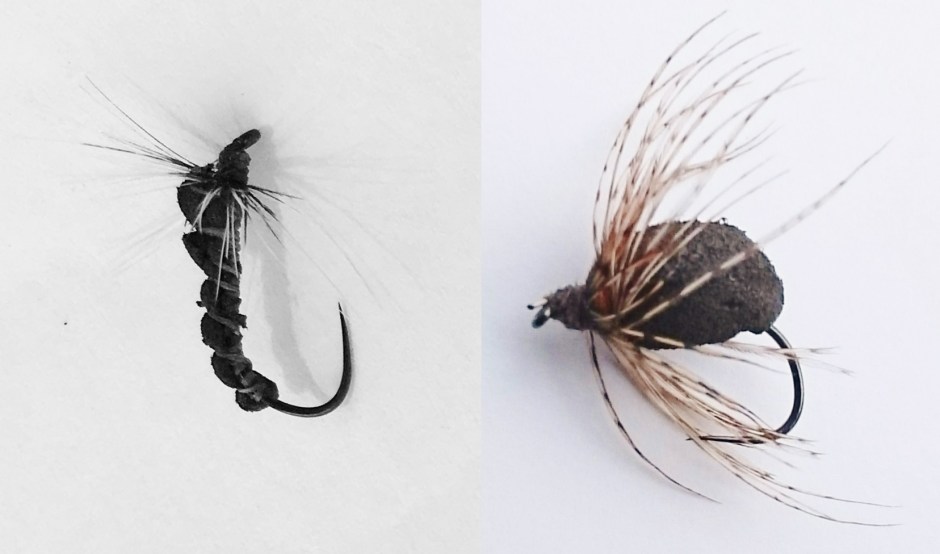
This fly has no history, I invented it. The Black Spider is a generic pattern that is a mixture of nymph, emerger and dry fly. It floats indefinitely because it is made with black Neoprene foam. The type of closed-cell foam that wetsuits are made from.

The body is tied in at the bend of the hook over a bed of black silk. It is brought forwards without stretching and is not ribbed. The foam retains its buoyancy and is the shape of a beetle or corixa. A small black hen or Partridge hackle completes the pattern. This pattern floats without dressing and will support a short length of sunken fluorocarbon tippet.  It’s great for educated trout and the takes are usually violent.

Both of these flies are best fished dead drift on the river or stationary on the lakes. I need to tie a few of each size, I tend to lose a lot in the trees.

trout


Daily Prompt: Trout Fishing Diary

dsc_2049

Last week I took my Trout Fishing Diary to the book binders. It’s a long story.

A few years ago, during a fishing holiday on the River Wye, I chatted to Bob Brookes in the bar of the Red Lion at Bredwardine. Bob showed me a leather bound book which contained photographs of huge carp and barbel he’d caught. It was a lovely book, full of memories and Bob was justifiably proud. Fast forward to January 2016. I wanted to keep a diary of my trout fishing and decided to use technology. After several false starts I designed and built a website using WordPress.  Other design tools are available but they are not as good. I kept the diary going throughout the season. The website made it easy to write a short story about each trip and to add a couple of photos.

dsc_2024

During the year I  was worried about the security of my diary and made regular backups. I also thought about printing a copy, just to be on the safe side. I remembered Bob’s beautiful book and thought about having a printed copy professionally bound. I researched different types of book binding, paper and book designs. I decided to keep the design of the book close to that of my website. I sourced high quality paper, edited the text for consistency and printed each page. In my wanderings around the internet I found Otter Bookbinding in Midhurst. I visited their workshop to discuss the binding and left the text block with them. About a week later the book was ready for collection.

It’s the only copy. It’s not for publication.  It’s a permanent record of my online diary that will exist long after I and the website have decayed. It contains 238 pages and about 250 colour photos.

Many thanks to Bob for the inspiration. I will attempt to repeat the process next year.

trout