13 September – Perryfields

It was an early start, I arrived at Great Springs at exactly 9:00am as planned. The night had been cold and there had been a frost, the first of the Autumn. Mist was rising from the lakes and several fish were swirling. They had been stocked the day before, it was nice to see life in the lakes after such a punishing Summer when the Trout were wiped out.

I had breakfast and wandered around the lakes leaving a trail of green footprints in the white grass. The sky was clear blue and as the sun moved above the trees, the air temperature quickly rose. There was a big cloud of midges under the trees and by next week the Trout will be taking buzzers.

IMG_1326-2000

As I drove away from Great Springs the telephone cables were lined with hundreds of House Martins warming themselves in the sun. They poured away, left and right, across the fields as I drove past, reforming on the wires after I had moved on. There were several Red Kite on the stubble at Stag Park, searching for leather jackets. They looked like tall, scrawny chicken at a distance and were too hungry to fly away as I rumbled along the estate road. The massive fields at Little Bognor had been rolled and harrowed, it looked like a desert landscape.

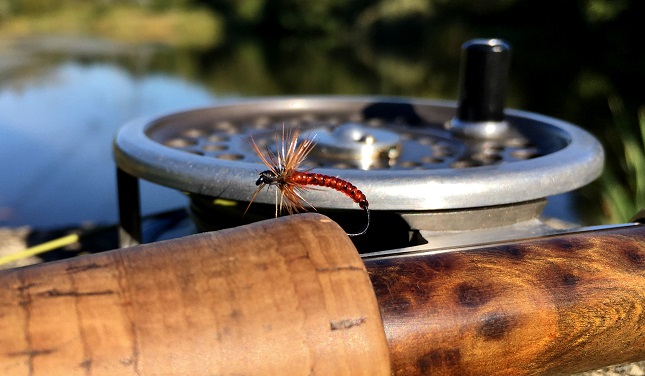
I planned to fish upstream from Keepers Bridge, mainly around Perryfields, which had been very productive for me. Most members don’t venture up there because it is a long walk and it is difficult to access the river. I had developed a series of heavy flies so that I could explore the deep pools more efficiently. They were based on the Copper Nymph but I had exaggerated every aspect. The size 10 heavy hook and thick wire ribbing would send the fly straight to the bottom of most pools.

IMG_1338small

I had a few casts in the First Pool, walked on and had a fish follow the fly twice in the Sandy Pool. That was encouraging. I walked slowly up to the Old Riffle, pausing occasionally to look and listen for Trout rising. I watched the water above the riffle for a few minutes and a fish revealed itself. I tried the copper version, then silver and red. The silver fly attracted most attention but the fish, more than one, sheered away at the last moment. They were educated Trout, not fooled by such an obvious deceit.

I found a good fish rising upstream of the Cow Drink and dropped the silver version around a branch, close to the ripples. A few casts later the fish took the fly and fought very hard. I bullied it away from snags, confident that the heavy hook would hold. It swam away quickly from the landing net.

IMG_1002small

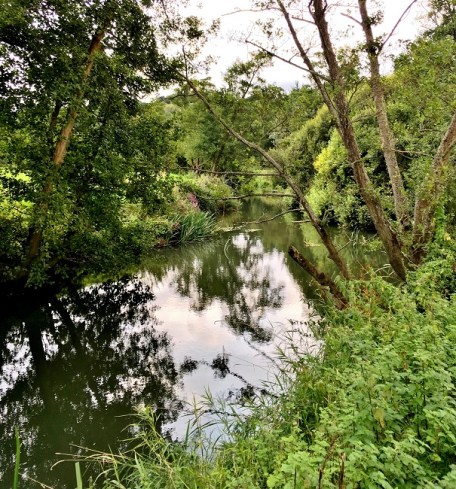
As I walked towards the bridge I saw a fish rise below the Four Alders and wondered if it was the fish I failed to catch a few weeks ago, it was in the same position. I crossed the bridge and walked along the tree line. I peeped from behind one of the four tree trunks but the fish was not where I expected. I eventually saw it in midstream below a clump of dying streamer weed. It was about a foot below the surface and holding position in the main current. It was just a pale shadow, not the fish I had seen before which was very dark. The cast was impossible. The Alder branches were low, the dead bankside plants were high and the river was narrowed by a bush on the opposite bank. It was a challenge. After a number of failed attempts, tangles and curses I managed to get a parachute Hares Ear in the water. The fish rose, inspected the fly and sunk back to its holding position. I tried an Adams and a Black Gnat with the same result. Only one in four casts actually resulted in a successful drift and I was running out of patience. I tied on a sedge pattern, a bit like a Walker’s Sedge only smaller, which landed perfectly first attempt. The fish rose, took the fly and bolted off downstream around the bend. The fly pulled out. I had to smile, it was a very well educated fish that deserved to get away.
IMG_0999small

While I had been sitting under the Four Alders plotting the Trout’s downfall, I’d heard another fish rising upstream. I walked back towards the barn and found a fish rising opposite the stile, under a tree branch close to the far bank. There was a line of thick bushes on my side so I re-crossed the bridge and sat on the wet grass to watch the fish. It had moved into midstream a couple of yards below another branch trailing in the water. I tried casting both sides of the branch but the fish would not move upstream for the fly. I thought a cast well past the branch, upstream of the trailing twigs might work. I launched a long cast, the leader drifted onto the branch and the fly swung across the current. To my surprise the fish swirled and took the fly. I hurried the fish through the branches and into clear water. For once everything had gone to plan.

IMG_1121asmall

I returned to the pool above the riffle and saw a fish rise between two clumps of rushes near the far bank. I put the sedge fly down in the gap and the fish immediately swirled but refused. It rose and refused on three more occasions. The fly was tatty so I changed it for a fresh one, the fish rose and took the fly in a big gulp but I lifted too soon. A fish splashed a few yards upstream. I crept behind some weeds and put the fly over the Trout which was not at all fussy and took with a bang. After landing and releasing the fish I crept back to the fussy fish. I flicked the line into the water at my feet and as I was lifting off to cast across the river, a fish rose to the fly with a big splash and disappeared towards the lip of the riffle scared but not hooked. I was tired from walking and my nerves were shattered from an evening full of elation and disappointment. It was a good time to leave the river. It had been an exceptionally good day.
trout


10 September – Little Bognor

I fancied a relaxing day beside a lake, walking miles in the early Autumn sun would be too much after a tiring weekend. I visited Little Bognor in the morning and it looked good, there were lots of fish rising on the lower lake. By the time I had visited the other lakes and river Beats, collated the catch returns and had lunch, it was 2:30pm. The south westerly wind had an edge. It had blown all the dust and leaf debris to the shallow end of the lake. Fish were rising everywhere, picking off emerging buzzers where the surface was clean and also among the floating Beech leaves.

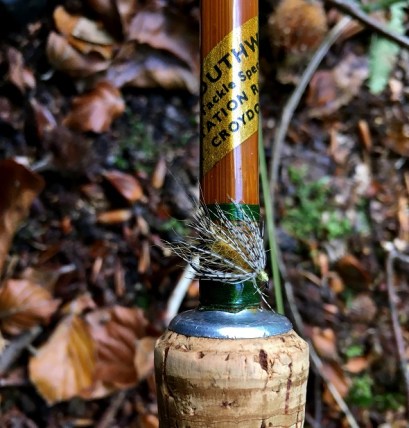
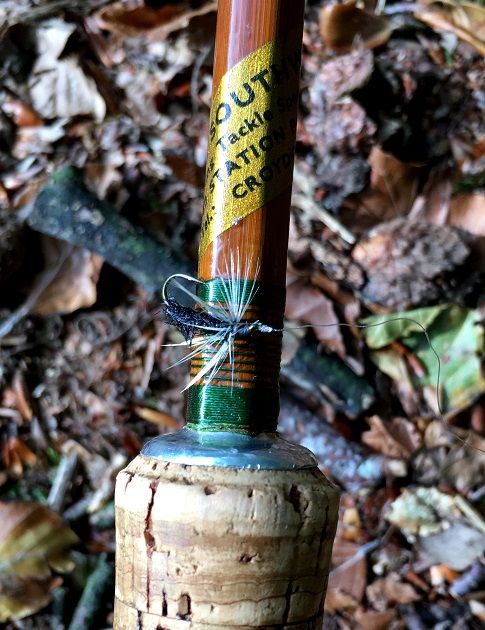
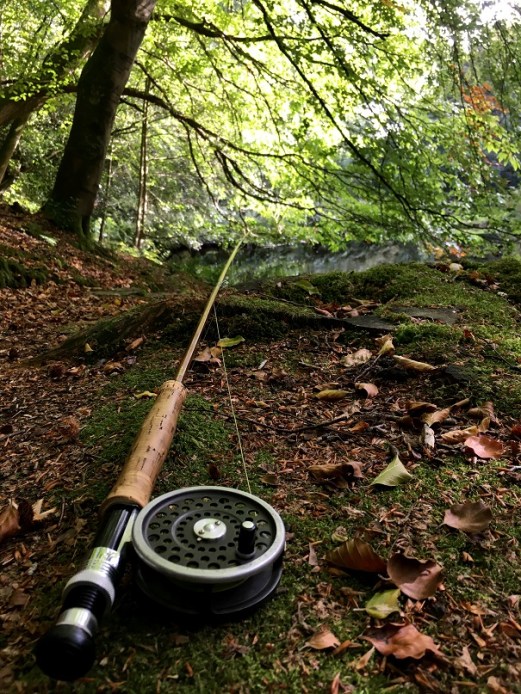
I would be fishing at close range and therefore chose the Bob Southwell cane rod. It’s slow action is great for flicking out flies under the trees and roll casting. The ten feet of tempered cane helps me reach over the ferns and avoid most of the snaggy twigs in the margins. The weight of the rod is not an issue as I spend most of the time watching and waiting for the Trout to come within range.

IMG_E1265small

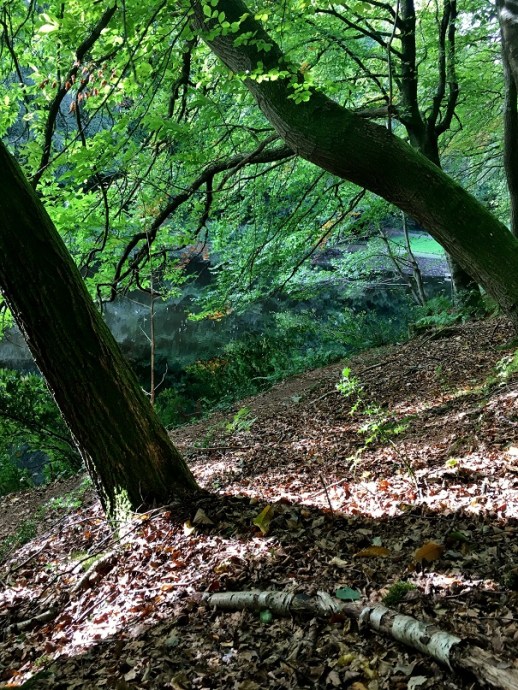
I started behind the ferns, sitting on the warm crunchy Beech mast. A constant rain of acorns and Beech leaves dropped into the lake and I quickly learnt to ignore the splashes. A sizeable branch crashed to the ground close on my left. Fish were cruising past just under the surface. I tied on a small black dry fly with a white hackle. A Trout ignored it but then turned, rose quickly and grabbed the fly. I didn’t allow for the momentum of the heavy rod as I lifted into the fish and it escaped.

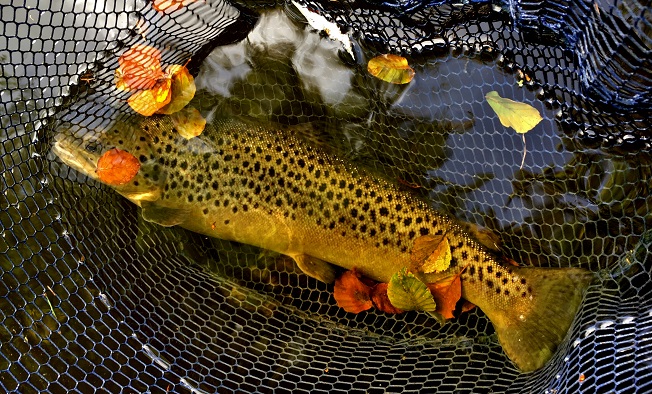
Normally, after losing a fish, I move further up the bank. However, another fish appeared. It took a fly off the surface and moved away, unimpressed by my imitation. Trout wandered into range every few minutes but as usual, the tippet was putting them off. I changed to a black buzzer with a sparse white hackle so that it would sink slowly. At first it floated but the fly became waterlogged and hung about a foot below the surface. I twitched it occasionally and as it neared the bank, there was a swirl and a good fish was on. It ran under the trees and I lowered the rod to keep the line out of the branches. It moved into the middle of the lake, then into the shallows. I thought it was foul hooked. After a long fight I drew it into the net, it was about 2lbs and fairly hooked in the upper jaw. I nursed it in the landing net and watched it recover. I lowered the rim of the net and the fish escaped, back into the brown stained water.

IMG_1269small

I was about to move but once again, a fish swirled so I resumed my seat behind the ferns. I used the same fly and after a few casts the line moved away and I was into another Trout. It was a smaller fish but spirited. When I eventually got it in the landing net I was surprised how small it was. It might have been a wild fish. None of its fins were deformed.

IMG_1273small

I moved up the bank and sat on the mossy hump at the top of the stone steps. A Trout was rising under the branches. I flicked the fly out several times but it was ignored. I lengthened the line and stupidly cast the fly into the branches. I tugged the line and a dead branch crashed into the water. I laughed but was annoyed. I walked around the lake and had a few casts in the corner near the old stone quarry.

IMG_1277small

A fish rose under the trees and I crept back among the Beeches below Rex’s dead Chestnut tree. I lost a fly in the margins, snagged the back cast, tangled the line in a small Holly tree and generally messed things up. When I managed to get the fly in the lake a Trout grabbed it without any warning. I held the rod low to my left as the fish ran up the lake into the shallows, it must have gone twenty yards. It was a long drawn out fight because it was foul hooked in the dorsal fin. I released the fish and as a party of other fishermen had arrived, decided to leave the lakes and head home. It had been a relaxing afternoon, a nice change from the river.

trout


8 September – Fish Pass

The road to Petworth was busy with lovely old cars on the way to the Goodwood Revival. For once the Defender was not the slowest vehicle in Sussex. After checking the lakes I drove to Coultershaw and walked across the field to see if the big Chub was still in the pool below the Fish Pass. The swans had torn some of the streamer weed away and while I watched, five big Chub cruised along the far bank then circled the pool. They were alert and feeding. The biggest fish was about 5lb. I checked the other Beats and was pleased to see that the muddy colour of the water at Taylors Bridge had gone and the water was clear. I returned to Coultershaw and stood behind a bunch of chest high balsam and dead cow parsley watching the Chub. They seemed to have a patrol route; slowly upstream along the far bank, turn downstream and swim alongside the weed, a couple of circuits of the pool, repeat.

IMG_1181small

The group contained five big fish and a couple about two pounds. There were no tiddlers. The odds of a good fish were in my favour if I could induce any of them to take. The first few casts had the fish following but sheering away at the last moment. They inspected the tippet on the surface. I cast upstream a little and had a good take from deep in the middle of the pool. It was one of the smaller fish. It buried itself deep in the weed and was tricky to extract. I netted the fish and released it to rejoin the shoal.

IMG_1185small

I remembered the large Trout I had seen jump on my previous visit. It had been close to the far bank of the weir pool where the current starts to slacken and where a bit of driftwood had lodged on a clump of rushes. I started exploring the deep water on my side of the pool with a black and copper spider. A fish rose in the hot spot and I immediately dropped the nymph close to the rise. As I twitched the fly back towards me I saw the line draw tight and lifted the rod but it was too late. The next cast the line moved again, two short pulls. I thought it was a small wild fish. I missed. The take on the third cast was positive and the rod bent alarmingly as the fish dived for the bottom of the pool. The fly line thrummed as the fish bored downstream. I was wary of the overhanging bush near the lip of the fish pass and steered the fish upstream into the middle of the pool. The Trout fought just like the three pounder I had caught above the Old Riffle a few days earlier. Except it felt bigger. It went on a long run upstream and the line fell slack. The size 14 fine wire hook had slightly deformed.

IMG_1209small

I walked upstream and fished for a while, running the fly under the overhanging Oak trees. I was just filling in time before my return to the Chub. When I got back to the Chub pool, two swans were tearing at the streamer weed and the fish had moved away. I will return next week.

trout


6 September – Fish Pass

The BBC weather forecast was for bright sun in the morning and an overcast afternoon. The forecast was correct but the weather was three hours late. The morning was too hot for fishing which was just as well as I spent most of it walking around the lakes and along the river chatting with other members. I found time for a cup of tea and a chocolate biscuit at Great Springs. There were lots of small Roach and Rudd swimming just under the surface but no signs of any Trout. I shared my seat with a dragon fly, a Red Veined Darter, but there were no other flying insects.

IMG_1157small

There were three members at Keepers Bridge and I didn’t want to share a Beat even though a Sea Trout had been caught there the previous day. I drove to the end of the railway line and had a leisurely lunch while listening to the mewing of a Buzzard. The bird sounded close but although I searched the sky all around me, I couldn’t see it. I walked to the bridge and was surprised by the colour of the water. It was very muddy. The water at Coultershaw, Rotherbridge and Keepers Bridge was clear. I thought one of the Sussex cattle had fallen in so I walked to the top of the Beat looking for a swimming cow. I didn’t find anything and returned to the Landrover, hot and annoyed that I couldn’t fish.

I remembered the big Chub I had seen in the fast water below the Fish Pass. I took the rod apart and drove to Coultershaw. Since my first sighting of the Chub I had waited for the nettles and balsam to thin out and for the streamer weed to die back. The time had come to present a fly. I peered over a clump of balsam and the fish was still there, tucked under the far bank. I had been very careful with my approach but the fish became nervous and drifted downstream into deeper water. Several gentle casts later there was a splash and I hooked a Chub. A small one, not the monster. I returned the fish and left the pool for later.

IMG_1171small

The bushes around the main weir pool provided good cover and I settled down on the grass covered gabion near the bottom of the pool. I used a long tippet and the heaviest Copper Nymph in the box. As I high-sticked the nymph at the end of a cast a Trout swirled around the fly but didn’t take. A few minutes later a fish rose in the centre of the pool, I extended the fly line, dropped the nymph into the ripples and it was immediately grabbed. As I was landing the fish another trout rose to my right, near the lip of the fish ladder. After I had released my fish, which was about 1lb 4ozs, I covered the other fish but it had gone, probably frightened off by the splashing.

IMG_1175small

I fished the pool where the river divides and then returned to the weir pool. A fish rose very close to the far bank but the wind prevented me from reaching it. A big fish jumped clear of the water in midstream, it wasn’t feeding. The clouds were gathering and the blustery wind was making it difficult to cast. I went back downstream to see if the big Chub had relaxed. I missed a take from a small fish, probably another mini Chub. I left the river but the late evening was overcast with a fine misty rain and I probably should have stayed.

trout


3 September – Keepers Bridge

The morning started with a bright overcast. The sky looked like an enormous lightbox with a uniform white from east to west. As the morning progressed the overcast burnt away and by lunchtime the sky was blue with high wispy clouds. I saw two red kites on the stubble at Stag Park Farm, they were the same colour as the soil. The gentle breeze from the north made it difficult for them to get airborne.

After checking the lakes I drove to Keepers Bridge. I’d seen from the catch returns that quite a few Trout had been caught there and I was confident that I could find some fish under the trees. I arrived about 2:00pm and was undecided which Beat to fish. The water had a dirty grey tint, as if something had disturbed the silt upstream.

There were no signs of fish. The complete absence of flying insects, except wasps, meant that there was no reason for the fish to feed at the surface. I decided to concentrate on the deep pools with a nymph and therefore headed downstream. As I was working a nymph through the shadow of the Alder trees above the bridge, I was surprised to see a fish swirl on the first bend.

IMG_1117small

I crept into position below the tree so that I could cast upstream and have wind assistance. The fish swirled again a couple of times but although I tried a parachute Pheasant Tail, Adams and Olive it wouldn’t take a dry fly. The glare was intense but I thought I saw the fish inspect one offering before going down, spooked by the tippet. I degreased the tippet with a dock leaf but it wouldn’t sink. I tied on a Partridge and Amber nymph which sunk a few inches. There was a big yellow flash about a foot down and I tapped the hook home. The Trout wandered about for a few minutes, not fighting hard. It looked a bit tatty in the landing net and I was sure it had been caught during the previous week. It was about 2lb and recovered in the net before disappearing into the weeds.

IMG_1121small

I decided to fish into the evening and thought the pools below Perryfields Barn would be a better option. I walked upstream missing out the pools I intended to cover on the return journey. As I walked past the Old Riffle there was a big swirl under an overhanging branch. It was a tricky cast through a gap between the branches and just above a clump of weed. The water was very coloured so I swapped to a Copper Nymph which would be easily seen.

I lengthened the fly line and put the fly over the fish on the first attempt. Before I had the chance to work the fly and while looking at the reel, there was a big splash and I instinctively lifted the rod. There was a big thump and the fish bored deep, it went down about six feet. The line grated on the streamer weed and the fish fought like a Carp or Barbel. I didn’t see the fish for a few minutes and was quite shocked when it surfaced, it looked big. I struggled to lift the landing net. The Trout was as long as the net ring and I estimated it to be at least 3lb, probably a bit more.

IMG_1134small

I walked upstream and fished the series of pools around the cow drink. Several Trout were rising but I only attempted the fish where I had a clear cast. The Sussex cattle were in another field and I intended to fish the other pools from the north bank as I walked back. I marked down the fish and crossed the bridge after a snack of berries. Yummy.

The first rising fish was in the middle of the shallow water of the cow drink. It looked like a small wild fish. The first cast was clumsy and I put the fish down. I moved to the Wide Pool where another wild fish was rising in the main current down the centre of the pool. I cast, the fish rose, was hooked and immediately came off. It was only a few ounces and a long distance release was the best outcome. I strolled downstream to the pool with three Alder tree trunks to hide behind. I saw a ripple under my bank and peered around the tree trunks. A very dark trout was hanging in the current about a foot from the bank. I lowered a series of dry flies but each was rejected. There was only a few inches of tippet on the surface but it was enough to alert the fish.

The air temperature dropped at 6:30pm as the sun hid behind clouds. I crossed over to the south bank at the riffle and walked slowly back to the Landrover. It had been a long walk but I was pleased with the results. It had been my first late stay of the summer. As the days cool and shorten there will be more opportunities like that.

trout