

Downsizing is a horrible business. The fishing tackle, watercolours and hundreds of books belonging to Robin Armstrong, the famous artist and author, had to be sorted and boxed for despatch to the local auction house. Funds were needed to pay for his care home. I volunteered to curate the books and fishing tackle. Thankfully, the valuable watercolours were not my responsibility.

Amongst the usual game fishing titles in Robin’s extensive library, was a battered, pocket size, black hardcover book with a missing spine and foxed pages The worthless old notebook caught my eye and I put it on the not-to-be-auctioned pile. Later, over a glass of wine, I carefully shuffled the loose boards, pages and inserts. The faded ink and pencil entries detailed the dressings of trout flies popular in the early 1900’s. Each dressing had an example of the fly attached to the opposite page. It was like John Veniard’s seminal ‘Fly Dressers’ Guide’ only better, I could see the actual flies. The book told a story about fly dressing evolution over more than half a century.

The flies were tiny, size 1 and 00 on the old scale, 14 and 16 in modern sizes. Fly tying vices were expensive and not widely available until well after WWII so the flies were probably tied in-hand. Inside the front board the inscription “Literature Notes for Senior Oxford Exam 1917” revealed the age of the notebook. According to the Bodleian library at Oxford, the exam was “for those who cannot afford …. a University education”.

The notebook enclosed a newspaper clipping about the late Peter George Frederick Seldon, a very keen angler, son of Ronald and Gertrude. An internet search revealed Peter’s obituary and some family details. The Seldon’s are a well-respected west Dartmoor family, Peter attended Blundells where his father was a master. I spent many months researching three generations of the family and eventually made contact with Gertrude’s granddaughter who told me that Gertrude, also a keen Dartmoor angler, had tied the flies. Delicate feminine fingers had dressed the tiny flies, hence their exquisite detail, she was a Devon version of the late Megan Boyd, King Charle’s preferred Scottish salmon fly dresser.

In 1917 Ronald went up to Oxford on a sport scholarship. The book was never used for its original purpose, writing poetry, football and cricket had priority. Ronald and ‘True met when he went to Tiverton to be a house master at Blundells. Granny ‘True was a much loved house matron. She used the book to compile a unique record of her fly dressings. The old flies and notes needed a safe home.

Gertrude recorded the particular requirements of individual customers, their patterns were listed alongside prices and quantities. “Two dozen Blue Uprights 4/-“, she ran a cottage industry. Some of her flies were tied direct to gut, later dressings were on eyed hooks with snecked points dating them to the 1950’s. Many of her flies were for Ronald who loved fishing on the Exe.
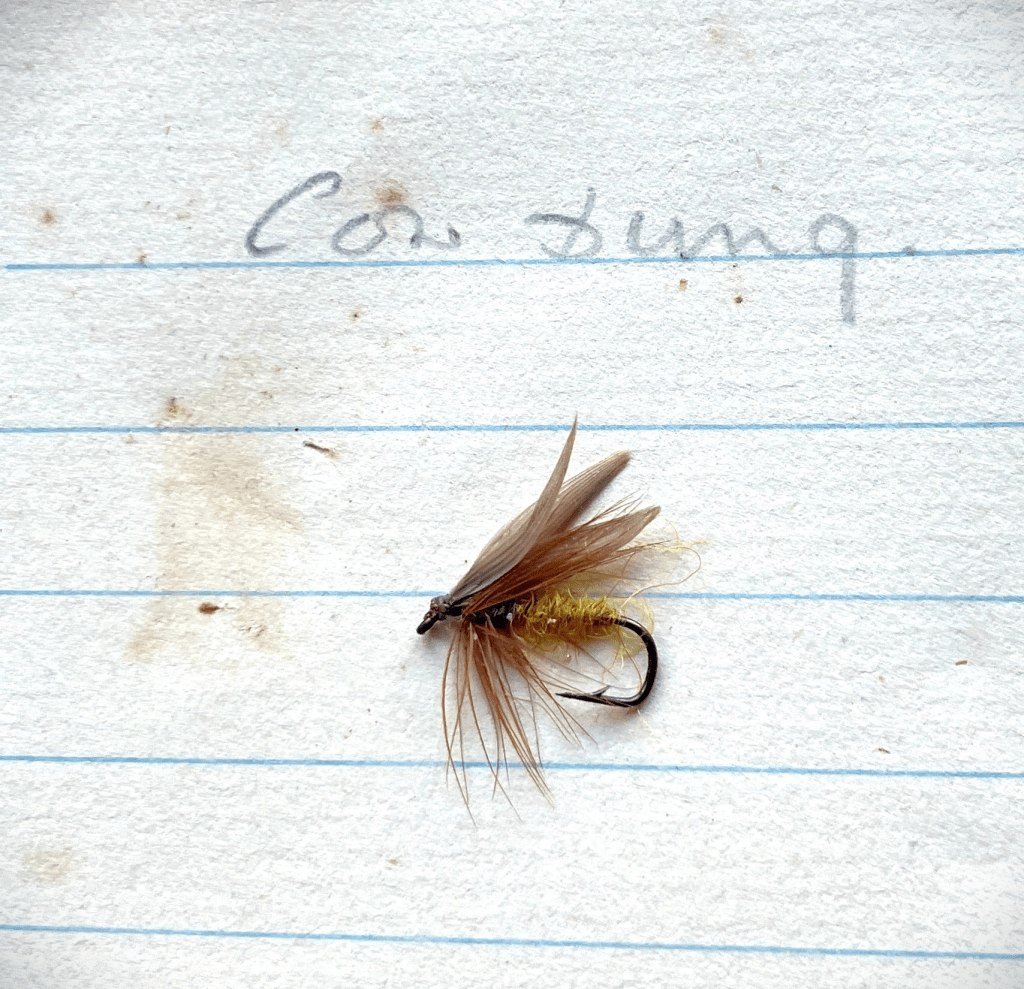
The handwriting and fly patterns change markedly towards the middle of the book. Dressings for Sweeney Todd and Church Fry, invented by Richard Walker and Bob Church in the early 1970’s, accompanied by crude sketches, were probably Peter’s work. I started fly tying over fifty years ago and because I couldn’t afford a vice, I dressed a spider, a buzzer and a black lure in-hand. I sent them to John Veniard who wrote back and encouraged me to continue, I subsequently bought one of his cheap vices which I still use. My shaking hands and poor eyesight prevent me from copying Gertrude’s work. Besides, modern barbless hooks made of fine wire and with overly complex bends don’t suit these old patterns.
Peter Seldon had his own water at Bedford Bridge on the River Walkham, my home river. Upon Peter’s death, his daughter quietly put the book aside to look at later, just as I had done. It turned out to be too technical for her and she passed it on to Robin Armstrong, a water bailiff for the River Walkham and Peter’s friend. I have returned the book to the Seldon family and the circle of ownership is now complete. The book resides with a volume of Ronald’s poems, written at Oxford but not in the book he intended. I am content to have read ‘True’s notes and seen the traditional flies. I hope my fishing diaries are as well preserved as Granny ‘Trues fly fishing book
. . . – – – . . .
 Sussex Trout Fishing ... and Devon