
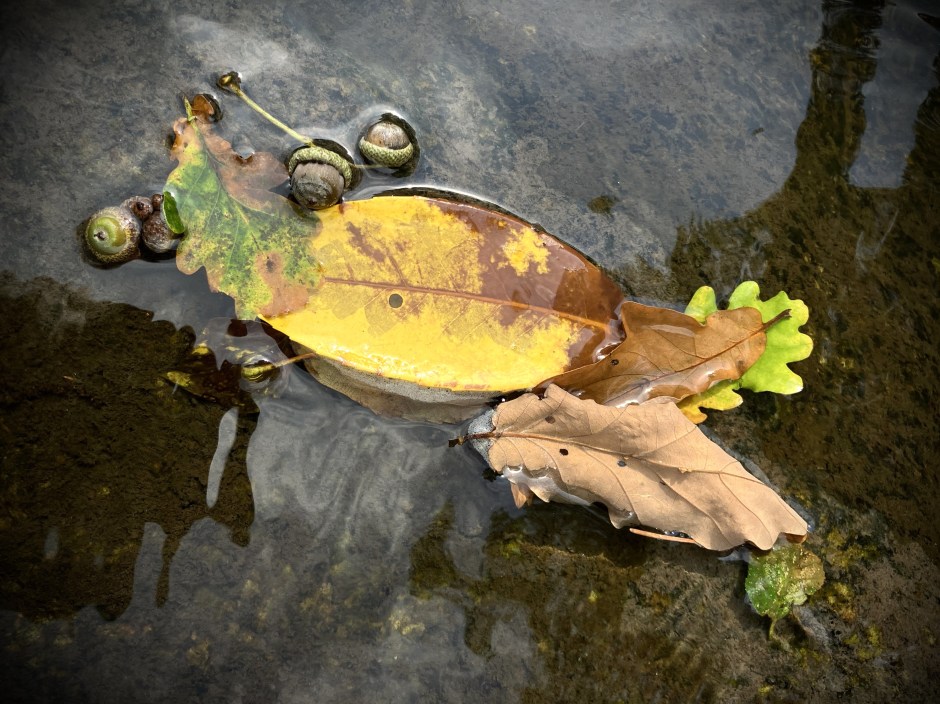
The grass hadn’t grown, the trees were stressed and were shedding leaves. It felt like early autumn. In the full glare of the morning sun it was warm, a cool north east wind ruffled the surface of the river. Nothing hatched. The crystal clear water and bright sunshine revealed every stone and crevice in the bed rock even in the deepest pools. The trout had nowhere to hide. There were acorns the size of garden peas trapped in the back eddies.
A king fisher whizzed upstream followed by a young dipper. Pairs of wagtails flitted from rock to rock and buzzards circled over the tree tops like vultures. As I searched the beach for a rock to sit on, a heron saw me and disappeared around a bend in the river.

I set up my rod away from the waters edge, all the time looking for a rise. As usual the plan was to explore the deep water with a weighted nymph. I spent nearly an hour concentrating on my wind assisted casts, using the long rod to mend the line and hold the fly in midstream. I mapped the pools features as I moved slowly downstream. At the tail of the pool I turned over a few rocks looking for bugs, there were none.

I walked downstream, scattering recently released pheasant poults, wondering if prospecting with a nymph was the right method, if I should have waited until dusk and if the trout had all been eaten by cormorants.
After several trips to the rivers on Dartmoor without catching a trout, I needed a boost in confidence. Burrator reservoir was low and my favourite stretch of bank would be accessible. I was surprised at how low the water level had dropped.

I stood back from the water line and covered the deep drop-off with a weighted nymph. The take took me by surprise, the line twitched and started to slide away. I lifted into a trout which put up a spirited fight and I eventually slipped the barbless hook from it’s top lip without touching the fish. Success. Relief.
The wind eased and the trout began to rise. I switched to a dry fly, a parachute pheasant tail sat nicely on the surface and was soon taken. I was looking elsewhere. I concentrated and landed two more trout. The fish were cruising just under the surface, moving in straight lines, sipping down buzzers, the bay was full of empty shucks. I swapped the fly for a Quality Street sedge and waited for a trout to come into range.

Stalking passing trout, landing the fly a couple of yards along their path, produced three more fish, one of which revealed the curly section of the fly line near the reel arbour.
I was very satisfied with six fish in three hours and celebrated with a pint and a bowl of chips at the pub. Confidence had been restored.
. . . – – – . . .
 Sussex Trout Fishing ... and Devon